Ad blocker detected: Our website is made possible by displaying online advertisements to our visitors. Please consider supporting us by disabling your ad blocker on our website.
For discussion of Tomas Alfredson's Film Låt den rätte komma in


-
sauvin
- Moderator
- Posts: 3410
- Joined: Sun Dec 06, 2009 5:52 am
- Location: A cornfield in heartland USA
Post
by sauvin » Sun Jul 01, 2018 5:33 pm
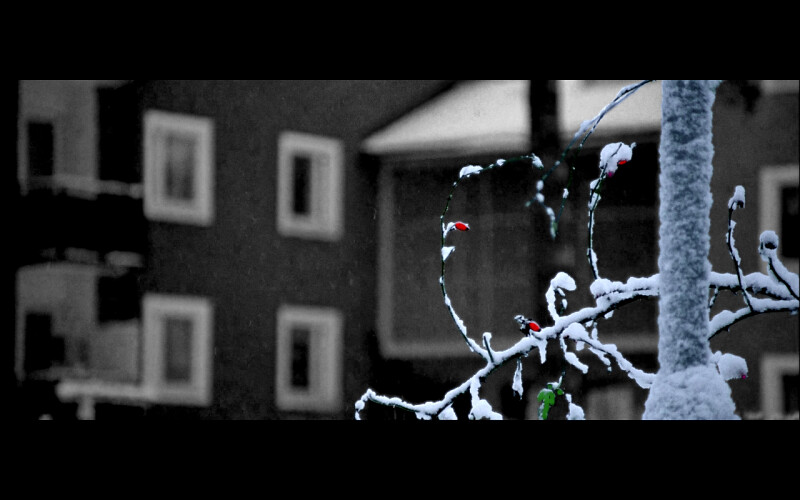
I don't think I ever understood what this scene was supposed to convey. It occurs just a few seconds before he runs up to the jungle gym where Eli sits waiting, to ask her how she solved the Rubik's cube.
This, along with the few seconds of Oskar retrieving the cube from the jungle gym where Eli had left it, are the "cleanest" in the whole movie, but I don't think I can explain what I mean by that. It may even be the wrong word, "clean". On the tree are something green and something red, things of
nature, and maybe the reason I'm drawn to it is the subtext that things don't die in the winter, they just hide and go into a coma.
Fais tomber les barrières entre nous qui sommes tous des frères
-
ltroifanatic
- Posts: 557
- Joined: Mon Sep 14, 2015 1:35 am
- Location: Australia
Post
by ltroifanatic » Tue Jul 03, 2018 5:02 am
I've wondered about that bush too.I think your right.Hibernation,a re-awakening. Waking to not such a "clean" future?Or maybe a better one?
Please Oskar.Be me for a little while.
-
dongregg
- Posts: 3937
- Joined: Sun Jul 21, 2013 10:58 pm
- Location: Atlanta
-
Contact:
Post
by dongregg » Tue Jul 03, 2018 5:43 am
It's a very arresting scene. It holds the promise of spring and the red buds the promise of life in the deepest of winter.
I watch the film with the video off and just take in the sounds. Then I watch the video (streamed from Amazon) with the sound off.
This scene, along with the two black dogs and so many scenes and sounds, ground the film in the commonplace and the extraordinary.
And yes, the color red throughout the film in the otherwise dreary settings that Blackeberg presents.
“For drama to deepen, we must see the loneliness of the monster and the cunning of the innocent.”
-
Pissball
- Posts: 115
- Joined: Wed May 31, 2017 6:37 pm
Post
by Pissball » Tue Jul 03, 2018 4:02 pm
I guess "nothing". Just a beautiful shot as cinematic resource, which this movie use a lot to length the time and set the pace.
As for the color, this is a capture I got, as you can see (at least this version of the film) it belongs as whole to the composition of the shot, the color-scheme is green+red, the buildings are desaturated on the background, and the flowers are saturated in first plane:

-
Opeth
- Posts: 490
- Joined: Wed Jan 23, 2013 10:08 am
- Location: Aotearoa
Post
by Opeth » Mon Jul 16, 2018 9:23 am
dongregg wrote: ↑Tue Jul 03, 2018 5:43 am
It's a very arresting scene. It holds the promise of spring and the red buds the promise of life in the deepest of winter.
I watch the film with the video off and just take in the sounds. Then I watch the video (streamed from Amazon) with the sound off.
This scene, along with the two black dogs and so many scenes and sounds, ground the film in the commonplace and the extraordinary.
And yes, the color red throughout the film in the otherwise dreary settings that Blackeberg presents.
I couldn't have said it better, this is one of the shots along with the one before & after that for some reason has really stayed with me when I think of LtROI. It has been far
too long since I've watched the film.
-
jetboy
- Posts: 609
- Joined: Sun Aug 23, 2009 5:22 pm
Post
by jetboy » Sat Aug 04, 2018 4:21 am
Hi guys it's been awhile. Hope everyone is doing well. Glad to see good topics still being mined and discussed. I had to put my two cents in on this particular topic, especially since I found so much meaning in the visuals.
I too love this shot as well as the whole medley of shots shown while that beautiful music is playing, ending with that bush shot. To me it sums up what the whole movie was about and that is that love can grow anywhere, including in the darkest places. The harsh winter signifies the darkness, or anti-life, and the red bud, which is kind of heart like, signifies love or life.
-
dongregg
- Posts: 3937
- Joined: Sun Jul 21, 2013 10:58 pm
- Location: Atlanta
-
Contact:
Post
by dongregg » Sat Aug 04, 2018 5:24 am
Hi Jetboy. Good to see your name again. There's a ton of new fan fiction in the last couple of years, the least of which is my own modest 10-part story that picks up a year or so after Karlstad. I commend to you a rip-snorting tale (in progress) by SpartanAltego and one by JoBerg (seemingly in an extended hiatus).
The scene with snow and red buds is one of the several arresting scenes as well as being rich with symbolism.

“For drama to deepen, we must see the loneliness of the monster and the cunning of the innocent.”
-
SpartanAltego
- Posts: 251
- Joined: Sun Nov 26, 2017 4:39 am
- Location: Michigan, U.S.
Post
by SpartanAltego » Sat Aug 04, 2018 5:56 am
jetboy wrote: ↑Sat Aug 04, 2018 4:21 am
Hi guys it's been awhile. Hope everyone is doing well. Glad to see good topics still being mined and discussed. I had to put my two cents in on this particular topic, especially since I found so much meaning in the visuals.
I too love this shot as well as the whole medley of shots shown while that beautiful music is playing, ending with that bush shot. To me it sums up what the whole movie was about and that is that love can grow anywhere, including in the darkest places. The harsh winter signifies the darkness, or anti-life, and the red bud, which is kind of heart like, signifies love or life.
Hi! Pleasure to make your acquaintance.
"The dark is patient, and it always wins. But its weakness lies in its strength: a single candle is enough to hold it at bay. Love is more than a candle. Love can ignite the stars." - Matthew Stover
-
dongregg
- Posts: 3937
- Joined: Sun Jul 21, 2013 10:58 pm
- Location: Atlanta
-
Contact:
Post
by dongregg » Tue Sep 11, 2018 5:21 pm
Now I think the red fruit could be acerola. Acerola could serve to mitigate scurvy, endemic in the northern latitudes when fresh fruit and vegetables were unavailable during winter, thereby keeping people healthier during the winter.
Nah, the acerola is a tropical or semi-tropical shrub.
But what the heck is the plant in the scene? I mean, one type of acerola shrub actually produces berries of this elongated shape, though most produce fruit that is round like a cherry.

“For drama to deepen, we must see the loneliness of the monster and the cunning of the innocent.”


